July 02, 2010
A taste of the DRC
One of the reasons why I applied for the job I currently have, was the possibility of travelling through Africa. It gives me the chance of going to places I would otherwise never consider spending scarce holiday time on. And that definitely applies to the Democratic Republic of the Congo, where I had to go to for a week.
I had to go to a place called Matadi, in the Western part of the country. So far away from the fights with the rebels in the Kivu provinces bordering Rwanda. In fact, the country is so big that thedistance from Matadi to those places is roughly the same distance as from my home town
to the Polish-White Russian border. And with their road infrastructure it would take weeks to
reach Matadi if they wanted to. So that leads us to two conclusions: one - I was safe from warlike violence and two - the road infrastructure of the DRC is bad.
In fact you can generalize that last statement to pretty much all infrastructure. Buildings look like they haven't been repaired in decades, which is probably also the case. The port I visited was build by the colonial power Belgium, in the early twentieth century. Since then most probably nothing was done to maintain the port in good condition. One indication would be the metal pillars supporting the quay side that were once as thick as a grown up man, and now are as thick as that man's arm. I assume this is what you get in a country that had a brutal civil war until recently and is one of the poorest in the world. How do you build up something if you don't have the building blocks to begin with?
I flew from Cape Town to Kinshasa, and then needed a short flight to Matadi. It is only 360 kilometres or so away, but because of the bad roads, you would lose too much time by driving there. You'd rather lose time, but slightly less of it, by waiting in a small airport for a flight with a blacklisted flight operator. I still haven't found out why they are blacklisted, and it was not that I had any other options, but it would have helped to know if I should be worried, or really worried. So there I was waiting for my flight with "Air Tropical".
The symbol of "Air Tropical" is a big elephant, which is probably the one creature in the whole animal kingdom that is the least likely to merily fly around. I guess "Air Tropical" can use a lesson or two in marketing. In spite of the ill chosen symbol and th
e blacklisting, wasn't really worried, to be honest. I figured that the pilots were not planning on crashing themselves, and since their job description says they have to actually be in the plane, I was convinced I would be ok flying with them. Still I couldn t help but looking at what they were doing, but that was only because I could look directly in the cockpit. It was undoubtedly the most
adventurous flight I have ever taken: a two propellor airplane with only 20 passengers, landing on an air strip consisting of trampled earth, and goats walking on it as we landed.
I was indeed safe from military conflicts, but there were potential other threats. Several exotic diseases with cool names but vicious effects were looming. For some of them I had a series of shots and a booklet to prove it. That vaccination booklet is as important as your passport, I was not allowed in or out of the country without it.
A disease you can't get vaccination s for is malaria, so I needed a way to deal with this omnipresent disease. Malaria is caused by a parasite that nests in your liver. All five types of malaria (there are 5, yes, there used to be 4 known but they discovered a new type recently) are transferred by the bite of an infected mosquito, turning that small creature into one of the most feared insects in the world. Malaria can be treated, but 2 types will never get out of your system.
You can imagine how happy I was to see the windows of my hotel room were equipped with a fine mosquito net. I was less enthused by the army of mosquitoes kept inside my room by that very net. A strategy was required. For part one of the strategy, I generously applied repellant all over me, making me smell like a giant bush of weird herbs. Secondly I wore a long sleeve shirt to sleep, and turned the airco down.
Mosquitoes only bite when the temperature is high enough. By making it nice and cold I was hoping to take their apetite away. And lastly I hopped and skipped around my room smacking and squashing as many mosquitoes as I could, wich made the walls and ceiling look like I emptied a tiny paintball gun on it
. I also improved my bruce-lee-squash, you know the one where you quickly grab a flying bug out of the air. I even made the appropriate kung fu squeels. As a final measure of precaution, I off course took malaria profylaxis (pills) and drank gin and tonic. The tonic contains kinine, a substance that makes mosquitoes not want to bite you.
With diseases taken care off, I more or less covered everything within my span of control. Bigger trouble makers that I could influence less were people. You see, the DRC is one of the countries were corruption is part of every day life. Coming from a first world country, with functioning governmental structures, functioning law and business rules, it is hard for me to deal with corruption. I don't like it, I don't condone it, I think it is wrong. But in many places where there are no structures, where law does not function an everyone is massively underpaid, corruption is a natural outcome. You give a guy a badge and he has power. You want to do something, you need a stamp or a paper from a guy with a badge.
But guess what, there is a problem or it is going to take longer than foreseen, or no no that is not possible... till a bank note appears and dissapears again. Then the papers show up, the problem is solved or they did find a solution. In other words, you need to lubricate a bit here and there. But in a poor country, a lot of lubrication is needed. And there are a lot of badges that need to provide paperwork. Who do you pay off? Who do you stand up to? How much should you give? Luckily the company provided help here. They provided a "fixer" for every transit I made in the DRC.
My fixer in Kinshasa was a middle aged, scrawny man. Neetly dressed, with spectacles balancing on a thin nose, he walked through a maze of people at the airports. Greeting many guards, talking to some, shaking hands, sometimes handshakes with bank notes in them, sometimes not. He made the process smooth. If I had to do all those things myself, it would have taken much longer and cost me dearly. I had read about travellers in the DRC having to buy their luggage back from airport personnel , or loosing their vaccination booklet because they handed it to the wrong customs officer. He also warned me not to take pictures.
I obviously had the exact opposite in mind. It turns out that the Congo is very wary of espionage. With several wars in recent past and ongoing fights I assume it is normal to be scared of any person documenting stuff. Coincidently, on my flight back to South Africa, I read in the newspaper that two Swedes were sentenced to death in the DRC, on the account of espionnage!! That could just as easily have been me! And also they had killed their driver or something, which I wasn't planning on doing, but still.
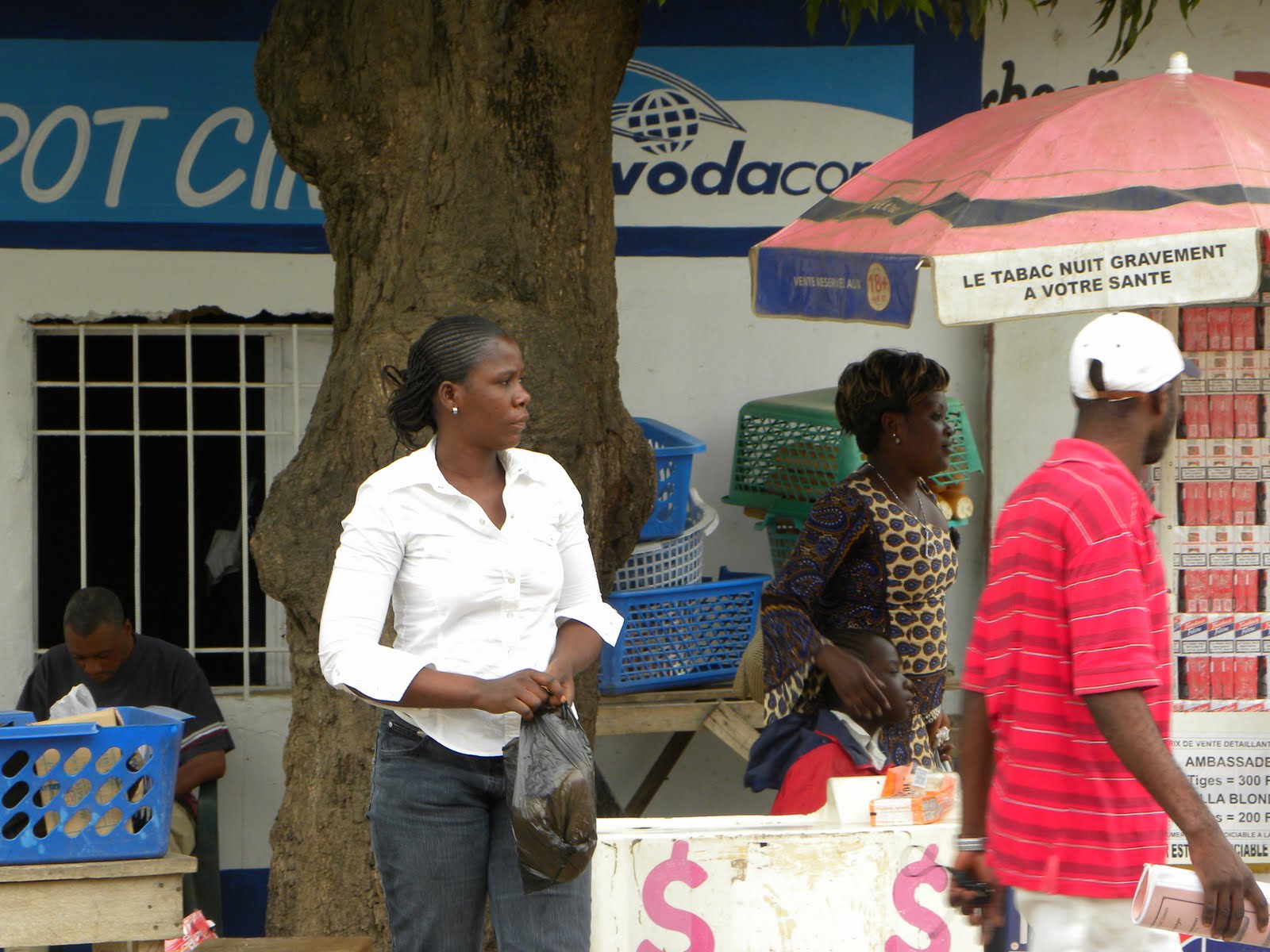
I assume you want to hear me describe what Kinshasa and Matadi were like? I am not going to spend too much time on that and let the pictures do the talking. Kinshasa is the dirtiest city I have ever visited, and that includes the cities in India. Very dusty, and soot everywhere because waste is burned in the streets and ashes mix with the sand. Traffic is a nightmare, as the roads
are in pispoor condition. But people smile a lot, and are friendly. They also like to remind me of the role of the Belgians in their recent history. Some did it to make me feel guilty, and
would be more inclined to give them almonds?, others because they seemed they finally wanted to confront a Belgian directly. Most remarcable was Yves, one of the guards at Matadi Airport. He blamed Belgium for not being a good coloniser. He said we should have left them with a Belgian language to speak, like the English did in Kenya. So I told him we were talking in French,
which is a Belgian language. But I was wrong, he said, because we speak Flamand et Wallon. How did French then end up being spoken in the Congo? He didn t know, but I was wrong and I was a bad colonist, because also - we did not found any university there. The whole conversation made me uneasy of course, but he could have made me feel much worse. In stead of telling me we should have founded universities, he could have questioned me on why "my king" came to steal copper, rubber and diamonds. Or why the Belgians choreographed the assasination of Lumumba, or why we allowed mercenary armies to cause bloodshed in his country, or why we backed up Rwandese rebel fractions invading the East, or why the Belgian army fought Arab slave traders only to start making slaves of Congolese themselves... I guess he either did not know about those dark pages in history, or those pages were written in Wallon in stead of French.
I'll start rounding off here, because I could write a lot more but I would digress from the reason of this blog. I'll just say I have seen, heard and read a lot of things which I find very fascinating.
The whole experience was a very good one, but I am glad it was not on my own account I went there. The Congo is very expensive, because everything is imported. The prices in the local supermarketare a lot higher than the ones in Belgium or Cape Town. Which is probably why someone is running a business importing goods from the Colruyt. That is right, everywhere I looked were items with the unmistakable "everyday" label, and prints in both French and Dutch. Oh, and the hotels I stayed in, even though they were average class, cost 240 EUR a night. So the plans I had of maybe making my way back to Europe in a car across the continent are put on ice for now.
June 01, 2010
Sport addicted
Never thought I would turn in to a real fan of any sport, but lately that is exactly what I have been doing.I ve been following the rugby competition here closely, going to every Super 14 game in Cape Town I could and even following games on television.
Because obviously I don't have any ties to any of the teams here, I chose the team of Cape Town as the side I would support. And it so happens that this team, The Stormers, had a great Super 14 season. In fact, they played the final of the Super 14 last weekend but lost against the Blue Bulls from Pretoria. So not the dreamed ending for the Stormers, but they had a fantastic season none the less. For me of course, it is even more fun to join a winning team.
Because obviously I don't have any ties to any of the teams here, I chose the team of Cape Town as the side I would support. And it so happens that this team, The Stormers, had a great Super 14 season. In fact, they played the final of the Super 14 last weekend but lost against the Blue Bulls from Pretoria. So not the dreamed ending for the Stormers, but they had a fantastic season none the less. For me of course, it is even more fun to join a winning team.As most people know, rugby is a big thing in South Africa, but mainly for the
upper economic layer of society. That is a result of rugby being played at universities (they have an own competition) and because only whites were allowed to play it in the Apartheid time. In Cape Town you will see that the supporters are mainly Coloureds and Whites, the Blacks like football (soccer) as their prefered sport. In spite of this historically grown division, rugby is played more and more by people from all backgrounds.
upper economic layer of society. That is a result of rugby being played at universities (they have an own competition) and because only whites were allowed to play it in the Apartheid time. In Cape Town you will see that the supporters are mainly Coloureds and Whites, the Blacks like football (soccer) as their prefered sport. In spite of this historically grown division, rugby is played more and more by people from all backgrounds.You could say that South Africans are obsessed with sports. Next to rugby and football, they are crazy about cricket and golf, and follow a whole list of other sports. Most people played at least two or three sports when they were young. No wonder you find so many athletic types around here. Although having all these beaches, lovely nature and nice weather will probably have a hand in it too.
Any activity that requires a bit of energy can be turned into a competition and will be broadcasted on one of the 6 sports channels they have here. One example is professional sport fishing. I don't know what the appeal is in it, but you can see bulky guys fishing in rivers, ponds or oceans. They talk about the bait they use, the lines, the hooks, how to reel in the fish etc... And they do catch the biggest fish imaginable, all shown on television. I wonder if those professional fishermen have large fan bases and if they have home grounds where they host fishing competitions and enjoy home advantage because they know what lure the fish like best...
To show all those sports, there are televisions everywhere. Every bar or restaurant, no matter how fancy or run down, has at least one television set to show sports. And sports are the one thing people seem to watch the most here. I am guessing now, but maybe they watch sports that much because they don't have that many soap operas or good entertainment on television. Surely, they have their own soap operas, like "Sevende Laan" which has the classic storylines of adultry, cancer, treason, illegitimate children and above all ever lasting love! (interestingly this show has conversations in 3, maybe 4 languages: Zulu, Xhosa, English and Afrikaans).
An other reason why maybe South Africans are so hung up on sports - and I am venturing a guess again- is because they are very good in a couple of sports. They have world class teams in cricket and rugby, they have extremely good golf players and other athletes like Oscar Pistorius aka Blade Runner (the paralympics sprinter with blades for legs who was olympic champion), Caster Semenya (the lady accused of being a man, remember that riot?). For a society that has so many great challenges in other areas, I can understand they would like to emphasize and enjoy the successes they have. And now the sports question on everyone's lips is: will Bafana Bafana be a success? Bafana Bafana is the national football team of South Africa. Now, it would be appropriate to say that they suck. And that is a bit of an issue when you are hosting a world cup. Especially because no hosting nation was ever eliminated in the first round. So the yardstick of Bafana Bafana's success appropriately became: getting through the group phase (alive). They needed a man to turn a jumble of mediocre players in a strong team that could face the likes of Mexico, Germany, Uruguay etc... So they hired a Brazillian coach. He has been working those Bafana players for months now, in training camps in Germany and Brazil. And seems to be succeeding so far! He booked 11 victories in a row now. He'll need those success stories because Bafana is in the toughest pool of the tournament.
In 9 days, South Africa will play Mexico in the opening game. Be sure that you'll be able to cut the tension with a knife, and that the whole country will sound like a hornet's nest, because of those damn vuvuzelas.
I won't be there to see the game though. Not even on television, because at that time I will be travelling back from Matadi in the DRC. Just in time for the rugby game of France against South Africa, for which I still have to buy tickets...
May 09, 2010
Braai-bing
Today I was involved in a car accident. Nothing bad, don't worry, I am fine and Shafeeka only has a couple of scratches on her back bumper. I left home to go on a shopping spree (which I still did and I bought some nice clothes but that's besides the point) in Canal Walk, a mall some 15 kms outside of Cape Town centre.
As I was waiting to turn into a street the car behind me was pushed against Shafeeka because a taxi had slammed it in the back. Luckily no one got hurt, the taxi driver, the man in the car behind me and his wife and child, and lil'ol' me, all unscathed. The two other cars were in a bad state though.
The taxi driver was speeding, and because I was waiting right behind a little hill to take a turn, he couldn't see me and the other car standing still. He slammed the breaks, but too late, with the known consequence. The taxi driver looked subdued, of course, but also very tired. His eyes were little slits, and he worked a bit slow. My hunch is that he just ended his 24 hour shift and was exhausted.
You see, most taxi drivers have to work 24 hour shifts in alternating days. So one day of driving, one day at home, etc... You often see the drivers sleeping in their cars, somewhere along the road for that reason. I have spoken with quite a few taxi drivers and most of them have this kind of rotation. Obviously that makes me wonder about issues as safety and reliability, and I wouldn't be surprised to hear that these types of accidents are quite common.
The little family had Malawian nationality, and when I presented my Belgian passport to the police officer I saw a slight hint of confusion taking over his face. As if he was thinking: "Three cars, three nationalities? Jasses!".
That might have been the reason that he dismissed me rather fast. Within 5 minutes I was allowed to go. I was spared the hassle of written testimonies and other paperwork. A quick look at Shafeeka's behind was enough to assess that I had no damages to claim and apparently that means I was no longer required to stay.
I hope the Malawian family will be able to sort things out with the taxidriver, because my gut feel tells me they will face a lot of hassle to get their damages paid out.
In earlier posts I told you about my dutch friend and colleague Florens, who became a father here in Cape Town shorlty after we arrived. His wife Claudia and their baby daughter Charlotte went to the Netherlands for a three week holiday. That means that Mr Florens regained a bacherlor status - to a certain extend of course. It was very easily decided that we had to do all kinds of things that you can't do with a baby carriage, and possibly a wife attached to it. Hence the mountaint trip I told you about, and a couple of parties of course. I also suggested to give Florens a township experience, by going to Mzoli's.
Mzoli's is a bouchery in Gugulethu, one of the biggest townships of Cape Town. They offer a very simple yet fun formula: You go to that place, order your meat, and they'll braai it for you. You can then eat it whilst enjoying the crowd and a beer bought in the local liquor store (which is basically a garage turned into a store). All of this steeped in township flair, which mainly means a lack of organization and hygiene, a good portion of chaos a lot of very friendly people and overall a lot of fun.
Over the years, Mzoli's has become a hangout for people that want to see and be seen. They drive up in their (sometimes fancy) cars, show off their sound systems, have a drink and dance and chat a lot. The success is slowly but surely changing the area. More garages are turned into shops or bars.
However, if you want your legendary Mzoli meat, you have to stand in line for a looooooong time, and you have to fight your way to the braai where you have to try to get your meat braai-ed before others do.
The first time I went there, me and my friend Rob decided to bribe one of the guys in order to jump the queue. But much good did it do, after a while we found out everyone was bribing the cooks!
The most amazing part about going there are the people. It is so easy to strike up a friendly conversation. And it is not an exception that someone tells you how much they appreciate it that white people are coming to a township to party and see how the majority of the South Africans really live. Those are often older people coming over to shake your hand and thank you for coming. I imagine its because they really experienced the days of apartheid the fullest (apartheid was only abolished in 1994).
Still if you go there, you shouldn't forget you're in a township. Crime rates are high, a lot of thieves and robbers are lurking, waiting for a chance to jump you. You're often warned for this, but so far I haven't seen, heard or experienced any of that. Let's hope it stays that way.


As I was waiting to turn into a street the car behind me was pushed against Shafeeka because a taxi had slammed it in the back. Luckily no one got hurt, the taxi driver, the man in the car behind me and his wife and child, and lil'ol' me, all unscathed. The two other cars were in a bad state though.
The taxi driver was speeding, and because I was waiting right behind a little hill to take a turn, he couldn't see me and the other car standing still. He slammed the breaks, but too late, with the known consequence. The taxi driver looked subdued, of course, but also very tired. His eyes were little slits, and he worked a bit slow. My hunch is that he just ended his 24 hour shift and was exhausted.
You see, most taxi drivers have to work 24 hour shifts in alternating days. So one day of driving, one day at home, etc... You often see the drivers sleeping in their cars, somewhere along the road for that reason. I have spoken with quite a few taxi drivers and most of them have this kind of rotation. Obviously that makes me wonder about issues as safety and reliability, and I wouldn't be surprised to hear that these types of accidents are quite common.
The little family had Malawian nationality, and when I presented my Belgian passport to the police officer I saw a slight hint of confusion taking over his face. As if he was thinking: "Three cars, three nationalities? Jasses!".
That might have been the reason that he dismissed me rather fast. Within 5 minutes I was allowed to go. I was spared the hassle of written testimonies and other paperwork. A quick look at Shafeeka's behind was enough to assess that I had no damages to claim and apparently that means I was no longer required to stay.
I hope the Malawian family will be able to sort things out with the taxidriver, because my gut feel tells me they will face a lot of hassle to get their damages paid out.
In earlier posts I told you about my dutch friend and colleague Florens, who became a father here in Cape Town shorlty after we arrived. His wife Claudia and their baby daughter Charlotte went to the Netherlands for a three week holiday. That means that Mr Florens regained a bacherlor status - to a certain extend of course. It was very easily decided that we had to do all kinds of things that you can't do with a baby carriage, and possibly a wife attached to it. Hence the mountaint trip I told you about, and a couple of parties of course. I also suggested to give Florens a township experience, by going to Mzoli's.
Mzoli's is a bouchery in Gugulethu, one of the biggest townships of Cape Town. They offer a very simple yet fun formula: You go to that place, order your meat, and they'll braai it for you. You can then eat it whilst enjoying the crowd and a beer bought in the local liquor store (which is basically a garage turned into a store). All of this steeped in township flair, which mainly means a lack of organization and hygiene, a good portion of chaos a lot of very friendly people and overall a lot of fun.
Over the years, Mzoli's has become a hangout for people that want to see and be seen. They drive up in their (sometimes fancy) cars, show off their sound systems, have a drink and dance and chat a lot. The success is slowly but surely changing the area. More garages are turned into shops or bars.
However, if you want your legendary Mzoli meat, you have to stand in line for a looooooong time, and you have to fight your way to the braai where you have to try to get your meat braai-ed before others do.
The first time I went there, me and my friend Rob decided to bribe one of the guys in order to jump the queue. But much good did it do, after a while we found out everyone was bribing the cooks!
The most amazing part about going there are the people. It is so easy to strike up a friendly conversation. And it is not an exception that someone tells you how much they appreciate it that white people are coming to a township to party and see how the majority of the South Africans really live. Those are often older people coming over to shake your hand and thank you for coming. I imagine its because they really experienced the days of apartheid the fullest (apartheid was only abolished in 1994).
Still if you go there, you shouldn't forget you're in a township. Crime rates are high, a lot of thieves and robbers are lurking, waiting for a chance to jump you. You're often warned for this, but so far I haven't seen, heard or experienced any of that. Let's hope it stays that way.
April 30, 2010
Flippin' fish, gorgeous gorge and other things...
41 days to go till the world cup… a countdown mentioned everywhere on a daily basis: in shops, on the radio, in the office, on television,… and while Cape Town and the rest of South Africa is counting down, I am counting up and… reach 6 months. Yes, highly estimated reader, I’ve been scurrying around on this speck of the globe for half a year now. 25% of the assumed time I’ll spend here. Does that mean that I have had enough? Not at all! It only makes me realize how I have to hurry up to do all the things I want to do here before I relocate.
In line with this thought, I have done a couple of wonderful things in the past three weeks, too much to mention in detail one post. So I’ll have to stick to a brief description and make sure I have a lot of pictures to acquiesce in your longings.
First of all, I’ve had quite a few friends from work visiting me from overseas (a nice expression essentially meaning “everything outside Africa”). I had my share of touring Cape Town and surroundings and eating out. Because with so many lovely places to dine, and at such prices, that is what you do.
I have become quite adept at giving tours in and around Cape Town. Soon the wine lands and Cape Peninsula will have no more surprises for me.
Although all these visitors had very different backgrounds and interests, they were all stunned by the beauty of the landscapes. And none of them were raped, mugged, cheated on, threatened or anything. So if you still had doubts of coming here, start planning and let me know when you’ll be coming.
Next to all of those visits, I went camping again. This time I was invited by a frolleague (friend + colleague) to join him on a trip. It must have been the first time I went away for the weekend without Shafeeka. She wasn’t angry with me, so I take it she didn’t mind. We went to the Cederbergen area, to a remote little place called “Suikerbossie”. We had a braai (not a barbecue because that runs on charcoal or brickets in stead of wood) and beer, and tried some fishing. I even bought a fishing rod and hooks and bait and all that, to do the proper fishing thing. I had tried fishing before in my life, but without the proper gear and no success (not sure if it’s correlated), so I went all out this time. The prey was yellow fish, and I am still not sure whether that refers to its behaviour or its colour. In a fishing manual it said that this type of fish usually bites between midnight and 6 am. And sure enough, almost at the exact stroke of midnight, we finally had movement on our lines. Two fish at the same time bit the bait on our two rods. Unfortunately our coordination was left to be desired at that time, on the account of us having to wait so long and having had a drink or two. I’ll rephrase: we were too drunk to reel in the fish. We broke one line, and on the other a fish the size of my under arm slipped out of our hands. But off hand, the best fishing experience I ever had.
Next to that, we went to a gorgeous little gorge not so far from where we camped. I’ll let the pictures speak for themselves.


An other big event worth spending some ink on is my visit to Maputo. One of the projects I have been working on evolves around contract negotiations with the terminal in the capital of Mozambique. It wasn’t a long trip, and not far either, but it was an interesting experience. We only spend one night there, and were of course focused on the meeting at hand so it was not like I was able to explore the city. Still it was very clear that Maputo is in a whole different category than Cape Town. Buildings and roads seem to be crumbling down. Quite a few roads were tarred before, but are turning into sand roads again. Here and there are potholes, some so big you could lose a 4x4 vehicle in it. Service in bars and restaurants is even slower than in South Africa.
As most countries in Africa, Mozambique is struggling with widespread corruption, lack of education, failing government apparatus and virtually no public infrastructure (roads, trains, waterways,…). I saw the clichés of lack of planning and low sense of urgency confirmed. All of this is very present in the terminal as well. I’ll illustrate with some anecdotes next to the pictures.


The terminal does not have good paving, in general. Causing basic problems as you can see in the picture.
These gentlemen work for Damco (a sister company) and were at the terminal to sort out an issue with a bulk delivery of coal. The bags were broken. To illustrate the lack of planning: there was no dedicated area for bulk goods, they just dropped the bags where there was space and it was convenient.
In line with this thought, I have done a couple of wonderful things in the past three weeks, too much to mention in detail one post. So I’ll have to stick to a brief description and make sure I have a lot of pictures to acquiesce in your longings.
First of all, I’ve had quite a few friends from work visiting me from overseas (a nice expression essentially meaning “everything outside Africa”). I had my share of touring Cape Town and surroundings and eating out. Because with so many lovely places to dine, and at such prices, that is what you do.
I have become quite adept at giving tours in and around Cape Town. Soon the wine lands and Cape Peninsula will have no more surprises for me.
Although all these visitors had very different backgrounds and interests, they were all stunned by the beauty of the landscapes. And none of them were raped, mugged, cheated on, threatened or anything. So if you still had doubts of coming here, start planning and let me know when you’ll be coming.
Next to all of those visits, I went camping again. This time I was invited by a frolleague (friend + colleague) to join him on a trip. It must have been the first time I went away for the weekend without Shafeeka. She wasn’t angry with me, so I take it she didn’t mind. We went to the Cederbergen area, to a remote little place called “Suikerbossie”. We had a braai (not a barbecue because that runs on charcoal or brickets in stead of wood) and beer, and tried some fishing. I even bought a fishing rod and hooks and bait and all that, to do the proper fishing thing. I had tried fishing before in my life, but without the proper gear and no success (not sure if it’s correlated), so I went all out this time. The prey was yellow fish, and I am still not sure whether that refers to its behaviour or its colour. In a fishing manual it said that this type of fish usually bites between midnight and 6 am. And sure enough, almost at the exact stroke of midnight, we finally had movement on our lines. Two fish at the same time bit the bait on our two rods. Unfortunately our coordination was left to be desired at that time, on the account of us having to wait so long and having had a drink or two. I’ll rephrase: we were too drunk to reel in the fish. We broke one line, and on the other a fish the size of my under arm slipped out of our hands. But off hand, the best fishing experience I ever had.
Next to that, we went to a gorgeous little gorge not so far from where we camped. I’ll let the pictures speak for themselves.
An other big event worth spending some ink on is my visit to Maputo. One of the projects I have been working on evolves around contract negotiations with the terminal in the capital of Mozambique. It wasn’t a long trip, and not far either, but it was an interesting experience. We only spend one night there, and were of course focused on the meeting at hand so it was not like I was able to explore the city. Still it was very clear that Maputo is in a whole different category than Cape Town. Buildings and roads seem to be crumbling down. Quite a few roads were tarred before, but are turning into sand roads again. Here and there are potholes, some so big you could lose a 4x4 vehicle in it. Service in bars and restaurants is even slower than in South Africa.
As most countries in Africa, Mozambique is struggling with widespread corruption, lack of education, failing government apparatus and virtually no public infrastructure (roads, trains, waterways,…). I saw the clichés of lack of planning and low sense of urgency confirmed. All of this is very present in the terminal as well. I’ll illustrate with some anecdotes next to the pictures.
The two cranes are quite old and need some work. The terminal has very big plans to change the infrastructure and the way they work. Soon the improvements will be visible.
If you want to see more pictures on both events, please go to this album and the other
Take care!
W.
April 08, 2010
In search of the bunny.
I'm quite convinced now that the easter bunny is a European rotant. Not an African one at least, because I haven't seen it hopping around here, let alone found some chocolate eggs. And I even went looking more than 200 km out of Cape Town but nothing. I did see some very nice sights, let the pictures speak for themselves (below).
I took the opportunity of the prolongued Easter weekend to go camping in the Cederbergen ("bergen" means mountains). I refrained from wild camping for a number of reasons: it was just me by myself - alone, it is very dry and didn't want to start a bushfire, and they have creatures here that can actually kill you. So I chose the certain safety and mild comfort of a camping site. And next to avoiding the aforementioned risks, I also found hot water and some genuine South Africans as company. Very talkative guys that don't shy away from a drink. Actually it would not be a lie to say they really liked a drink, although they were still very well behaved. As so many drunken people do, they started talking about politics in South Africa. The inspiration did not only come from the alcohol in their circulation, but obviously also from the recent brutal murder on a prominent extreme right Afrikaner politician named Eugene Terreblanche. Mr Terreblanche had some terrible beliefs and was also killed in a terrible way. Food enough for conversation around a camp fire.
The trip itself was awesome, although not flawless. I made some rookie mistakes that are simply ridiculous, really. I had decided to go camping on the very last minute, so in my haste to throw my stuff in Shafeeka's trunk I had forgotten a few essentials. I didn't have fire, flash light, mousquito repellant and to top it off: no tent pegs. So I had to improvise a bit to sort things out. Luckily I found some easy solutions quickly. I broke the legs of a broken camping chair I'd found in pieces and used them as pegs. A local shop provided matches, candle and mousquito repellant. So I undid the shameful mistakes. Hikingwise it was not the best trip either. But this time I was not to blaim. The road I had chosen on my brand new map was - just like the desired easter eggs- simply not there. I was looking around for it, walking through the area, following the river along which the road was supposed to run, but could not find the pathway. After more than an hour of crashing through the bushes, whilst tapping a long thin stick in front of me to scare away snakes, I found myself walking through a dried out part of the river bed. I would have powered through if I hadn't been alone, but my sensible side won it over my reckless side and I made my way back. It took me an other hour and a half to lumber through the thicket and through the river but I got back without problems. It was a bit frustrating but satisfying at the same time. Can you have those two feelings at the same time? I think so; I was happy being out there in nature, trying to find my way by myself, but frustrated that I couldn't get to the top of the mountain I had planned to climb.
The Cederbergen area is very beautiful and is yet again very different from the winelands, the Table Mountain area or the Atlantic Seaboard. It is famous for its citrus plantations. In springtime it is supposed to be full of flowers so I will definitely go check that out. And I would like to see some San (Bushmen) rock art there too as they have quite a few sites with those old depictions. You can also visit the rooibos tea plantations there which is an other reason for me to go back.
Subscribe to:
Posts (Atom)