November 28, 2010

All Things Flying

There is only 5mm of plastic between me and certain death. Then why am I so calm? I should be panicking. The others seem very tense and keep asking silly questions to keep their minds busy, to push the fear away. They look pale, almost green even, as I should too but I don't. I look closely at the door, it is an assembly of strips of transparent plastic, bolted together with rubber joints so you can roll it up. Clearly a handyman's work, not by a company with safety procedures and strict rules to adhere to. It makes me wonder how many safety systems it has, as I expect would be required for airplanes flying at 6000 feet (2000m).
I look at the back of the airplane and can see the cables leading from the levers in the cockpit to the rudder and flaps. Again not a reassuring thought that I can touch the cables, pull them even
and thus steer the little aircraft. I look through the oval windows and enjoy the stunning view. From this side - Tableview - you have an amazing view of Table Mountain, Signal Hill and Devil's Peak, with the city cradled between them and sprowling out. I see the new stadium and robben island, all under a clear blue sky, not a cloud in sight.
My partner gives me instructions and urges me to come closer. I have to manoever around which is very difficult in the confined space of the one propellor aircraft. We shuffle on the floor, as there are no seats, just one open space. Oks are signalled back and forth. Someone rolls up the door and air comes thundering in. The first pair goes, then it is me. I can feel a change in my
body and oddly enough I think about how my pancreas secretes adrenaline, heightens my senses. I think of how it dilates my pupils, sharpens my hearing, gives me more strength if I should need it. In the mean time I do as instructed, sit in the doorway, feet over the edge, legs folded under the belly of the plane. Head backwards, tilted sideways so I wouldn't knock out my tandem instructor.
For a brief moment we sit there, and I see the absurdity of the idea. I'm looking down two kilometers, to fields, dunes, ocean, cars, houses. I am strapped to a man I met one hour ago,
about to jump out of an aircraft. One minute of free fall, speed increasing every second up to around 300kms/hr, then pull out a piece of cloth tied to our backs with ropes so it would slow - not stop- us falling and allow a certain amount of control over the descend.
I decide not to scream. There is a tumble head first, and we fall. I hear myself screaming, of course. My mouth is dry within a second, from all the air flowing through it. Imagine stretching
your lips around a hair drier and switching it on, same effect. As we are falling, arms and legs open, looking around, a strange thing happened. I felt in control, at ease, really enjoying
the view. I would have wanted to stay up there, I felt perfectly safe. Reality was different of course.
There was a big tug and our body positions changed upright. The noise of wind diminished and we circled down. After an easy landing, I was back on the ground. I had done my first skydive.


-------------
A couple of weeks ago, a big fair on military equipment was held in Ysterplaat, a military air base 30 minutes drive from Cape Town. Different heads of state, army officials and security companies from all over Africa came to admire the latest in military equipment, ranging from tanks and heavy duty vehicules over ammunition and weapons to armor and soldier's gear.
It was combined with a two day airshow of different types of helicopters and airplanes. My knowledge of aircrafts and military equipment is limited to the type of sound they make. Planes go swoosh, helicopters go dugdugdug and guns pow pow (and variations). I am also capable of distinguishing a helicopter from a plane. By locating the propellor(s) I can fairly confidently say if it is a helicopter - when the propellor is on the roof - or a plane - when it is on the side or front. It became a bit difficult with the jet plane concept where there is no propellor at all, and I almost
confused a tank with a fighter jet.
So with no knowledge of the war toys on display, and frankly no interest in acquiring knowledge on them, I just stuck to ushering ooohs and aaaahs. A perfect spring day, with the sun stinging and a cooling breeze, my friend Thomas and I admired the butch vehicules. There were stunt pilots flying in difficult formations, making loops, and helicopters showing how they pick up and displace jeeps, military men parachuting and abseiling out ouf helicopters. Big fat airplanes showing how manoeverable they are. One such carrier aircraft of the US army needed only 300m or so to stop after touching ground. Truely amazing.
In all, a very enjoyable afternoon. I left with reddened skin and the confirmation that I'm not into mechanical stuff.


November 22, 2010

...and off again


Before I start this new post a confession, or rather an observation, for when you confess you need to have sinned and I don’t think I have.

I noticed that my drive to write new blog posts fell away completely shortly after my birthday. My birthday must have been the least noticed one since I was born. I received few birthday wishes and almost no gifts. I know I like my share of attention, yet I still don’t see myself as someone who really craves it. However, I was noticeably upset not getting the calls and cards I had secretly hoped for.
Now, of course I rationalized all of this. I know how birthdays in general are hard to keep track of. I myself rely on the birthday calendar in Facebook to keep track of most people’s special day. And I know all of us are submerged in our own lives, doing daily routines, and that with me being away, there is a lack of stimuli to help one remind my birthday.
But in spite me being able to consciously put the feelings of dissapointment in perspective (there is a root in vanity in them, and I don’t subscribe that attitude) I have to confess – there it is- that I did not feel like writing any more. Did I want to punish? Did I seek vindication? Not deliberatly, but it seems like once more the subconscious prevails.

But let’s consider it water under the bridge. I was pleasantly surprised to hear how many people actually seemed to read the scribblings on this blog. You might argue that there is vanity in me writing more to get attention, but then I would stick out my (perfeclty shaped) tongue to you, turn around and walk away, acting like you’re just a whiff of a bad air and stroking my golden blond manes.

Now we’ve got that out of the way, I’ll give you some updates, still in chronological order. Let’s see how many I can post in the coming weeks…

----------------------------------
Cote d'Ivoire, my new experience with traveling in Africa. And what a pleasant experience it was, once i managed to get there...

I had to be in the capital, Abidjan, for two days worth of meetings. With the flight network offering limited possibilities, I had to fly all over the African continent to get there. You might want to have a map of Africa next to you if I describe you my route: From Cape Town to Johannesburg, to Nairobi (Kenya) to Accra (Ghana) to Abidjan. All fun and games, and not too big of an issue if it weren't for the flight from Nairobi to Accra departing with a delay of one hour. One hour delay and I only had 50 minutes to catch my connection to Abidjan, and since basic math applies pretty much all over the globe, I had to find a way to make the plane fly super fast, or would be bound to miss my connecting flight. My hijacking skills are yet to be developed, and the captain wasn't available for discussions (something to do with him busy flying a plane) so I touched ground in Accra too late and had to stay there for the night.

The flight operator arranged a nice hotel, transportation and food. The staff and all people I met were very professional and helpful. I did not need a fixer, like I had in the DRC. I did not need to bribe anyone, and only had to ask or explain everything once. So all in all not a bad experience, I just needed damage control so I would not arrive too late in Abidjan. But first I tried to catch a glimpse of Accra.

Accra was definitely in a different league than the DRC, based on what I saw there. I have noticed you can gauge the (economic) state of a country by things you see in the street:
- the type of cars: a lot of new and/or expensive cars mean there are people with money. A lot of 4x4 vehicles means the roads are in bad condition overall. Vans and trucks mean there is room for large scale economic activity.
- How many people are selling in the street, and what they sell. If they only sell bare necessities- food, drinks, alcohol-, it means either people have no money to purchase other items, or it is too expensive to trade in them. If they sell other items – jewelry, gadgets, books, toys- it means small time entrepreneurs can find the means and the consumers to run a shop.
- The presence of big supermarket chains. They do there homework before they enter the market. Especially the international chains. You could look at them as the flowers of the economy: if the soil is rich enough (consumers) and the climate accommodating (government policies) they will bloom. If one of the two is lacking, they won’t sprout.
- Billboards in the street: are they advertising products or mainly glorifying the ruling president. - The buildings and public infrastructure: how many skyscrapers, how big are the houses, in what state are the houses and roads, …

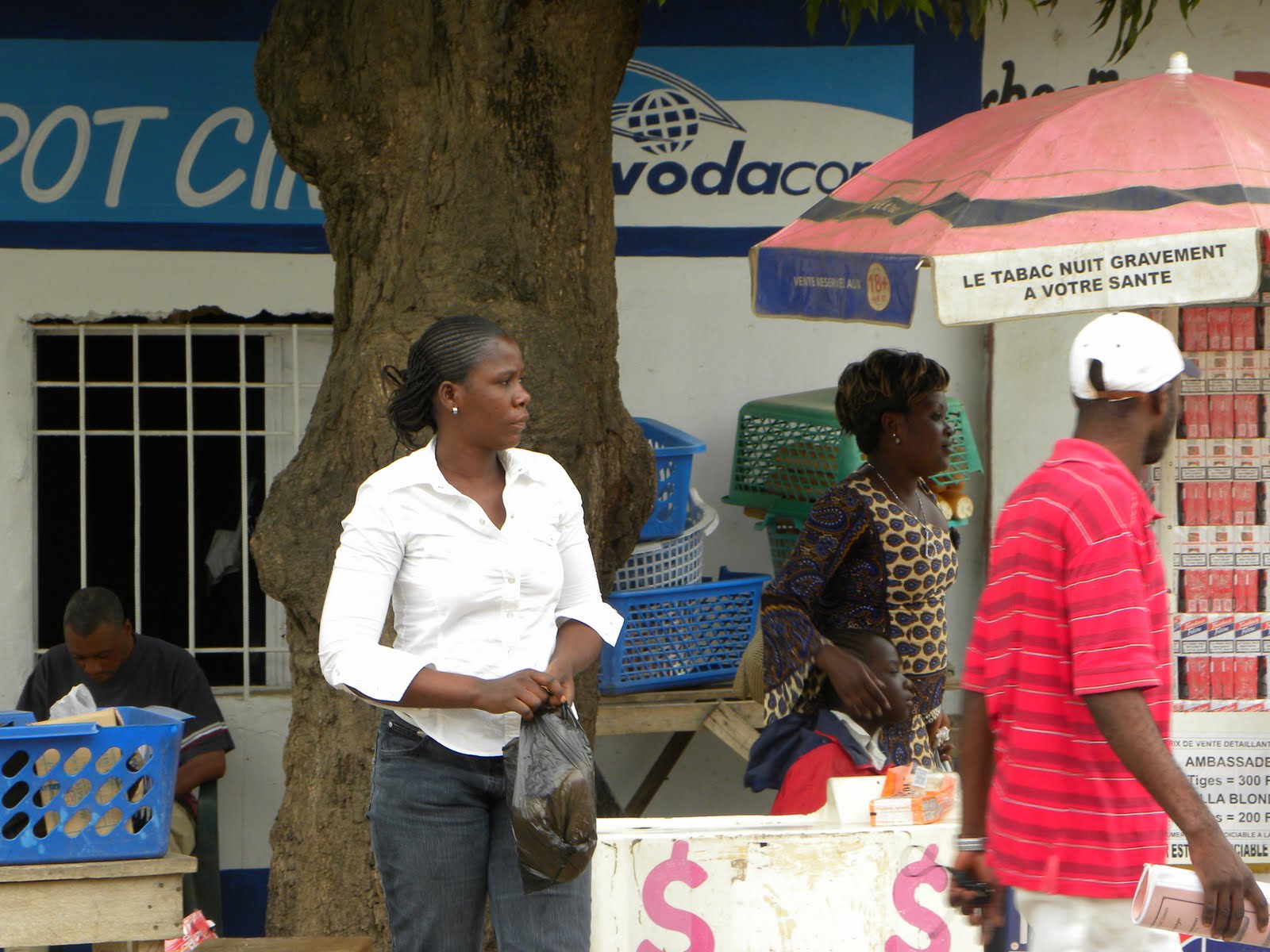
Measuring Accra on these criteria, they scored the highest of the few cities I have seen in Africa. Hawkers were all around selling all kinds of things from food to phone cards over toiletries to clothes. A traffic jam looked like a moving supermarket almost. There are quite a few international supermarkets, and you can see their advertisements on big bill boards all around (side note: there is a brand called “Uncle Sam” complete with the American symbol and all, selling halaal food. I would love to serve a nice plate of that to some of the hard liner anti-muslim US citizens). Cars are new and sleek, no 4x4s needed here and the houses looked nice and big in the (upmarket) area I walked through.

So Accra was nice, granted, but I needed to be in Abidjan, and as fast as possible actually. The replacing flight would leave the following day in the afternoon, thus making it impossible to do any of the work planned for most of the day.
I moved out to investigate other options. There was an other flight leaving in the morning, from an other flight operator. I decided to spend extra money for this ticket so I could arrive before noon.
The next day, I was on my plane, a standard boeing 737, with luggage all checked in and safely on board, ready for the 45 min flight. When we were airborne for about 15 mins, the pilot came on the radio and mumbled some French words about a defect and that we had to return. There are only a few messages that are unsettling when you are flying, but this was definitely one of them. Even more so for the Ghanaian passengers, who speak English and couldn’t understand the pilot but did see the unrest with their Ivorian fellow passengers.
Back on the ground in Accra, the pilot announced that two electrical generators failed in mid air. Two. I am no plane mechanic or engineer, but two generators failing sounds like a whole lot. Especially considering that I am used to taking flights where a total number of zero generators fail, zero failing generators therefore also being the average per flight. Oddly enough I did not panic at all, I kept reading my book. I figured that I could not do anything myself anyway, and that I could only make the pilot’s job more difficult by panicking.

As we were safely on the ground, it was time to observe a big difference in culture. The passengers on board did not start asking questions to the flight attendands. They had a chat on the situation, yes, and they did not like it. But they remained quite calm. No one started shouting, and there was no individual getting angry with the pilots or anything similar. That would be behavior that could be expected if this were to happen in Europe. Or people getting scared maybe, and nauseous with anxiety. I think the crowd, being almost exclusively African, was accustomed to these type of challenges and therefore able to handle it calmly. They knew something would come up eventually.
But I had bought this ticket to get to Abidjan earlier than my original back up flight, which was still set to leave a couple of hours later.
So I politely asked a stewardess when she thought there would be clarity on the back up plan. She reassured me there were two planes contacted to take the people of this flight. One was secured already, the second plane they were contacting now. But she couldn’t tell me when it would all happen earliest, so I asked the senior flight attendant. Yes, he said, the first plane was confirmed and the other looked like would be secured any time soon. But it still had to land in Accra. A slightly puzzled look from my side. Still to land? Yes, it is leaving Abidjan now and flying this direction, we expect it to land in three hours. I thought about all the hassle and the time it would take before that plane would actually take off. The first plane would be my best bet. So how many people can board that first plane, I inquired. Oh, about six or seven probably. A very puzzled look from my side. Six or seven? Yes sir. And the other plane, how many people would that take? That plane is not confirmed yet, sir. Yes, I understand, but how many people would it take? Around sixty maybe. The puzzlement changed to disbelief. I turned around to the crowd of passengers behind me in the Boeing 737 and quickly estimated around 120 people present. I smiled and thanked him, he did not seem to notice I questioned his contingency plan.

Some other passengers saw me asking questions, and watched me as I calmly stepped out of the plane. I asked for my luggage, and set course to the agency that sold me the ticket. I had 1 hour and a half to sort things out and catch my original plane: get a refund for my ticket, get my luggage, and check in again for the other flight. Much to my surprise, it all went smoothly. I had expected at least some shrewd villains to want to take advantage of my vulnerable state by asking for a bribe or wanting to keep the money for the ticket. That would most definitely have happened in India, I ll take poison on that. But none of that, some of the luggage attendants even scolded a colleague for not being professional because he was slow.

When I boarded that plane, I saw my previous passengers sitting in the hall. Still sweating and puffing and not certain of their options. I wonder how long they remained there.

I finally made it to Abidjan, and was able to do all the things I had to do. But they were very worried there as I hadn't been able to update them on the delays. It's the last time I'll decide to leave my cell phone at home "because I have never needed it before, what could possibly happen"...

August 18, 2010

Roaming Roads and Reserves

I took a day off, a Friday, and as such prolonged my already extended weekend ( Monday was a national holiday of some sorts). I ve been yearning for a decent vacation as I haven’t taken any since I arrived here. And that is 10 months now. Since work currently doesn’t allow me taking 2 weeks off, I settled for the long weekend and headed out to the Garden Route.

The goal was twofold. Firstly, to see and experience beautiful nature. Secondly, to finally make it out the Western Province. I haven’t even been close to the borders of the province I live in, because of it’s vast size. Western province has a surface of 129,370 km2, very close to the size ofEngland (130,422 km2) and about 4 times the size of my home country (33,990 km2). So you can understand it is quite a mission to get out of the province, if you only have a weekend’s time.

The plan was basic, the route was chosen, Shafeeka packed and I was ready to rock. In the four days I had, I did four national parks.


First one was called “Wildernis”. I’ll give you a candy bar if you can guess what

that Afrikaans word means in English. The legend goes that a woman asked her fiancĂ© to live together in the wilderness (did I just give it away now?) for a year before they would get married. The guy, one of the clever type, built a hut in the forests near the ocean and named the hut “Wildernis”. And that is as far as the legend goes. Quite boring, I know. No man eating creatures, no daunting challenges, nothing. The same goes for the nature reserve. It was more of a resort with holiday houses around a lake, and it was hard to really feel out in nature.

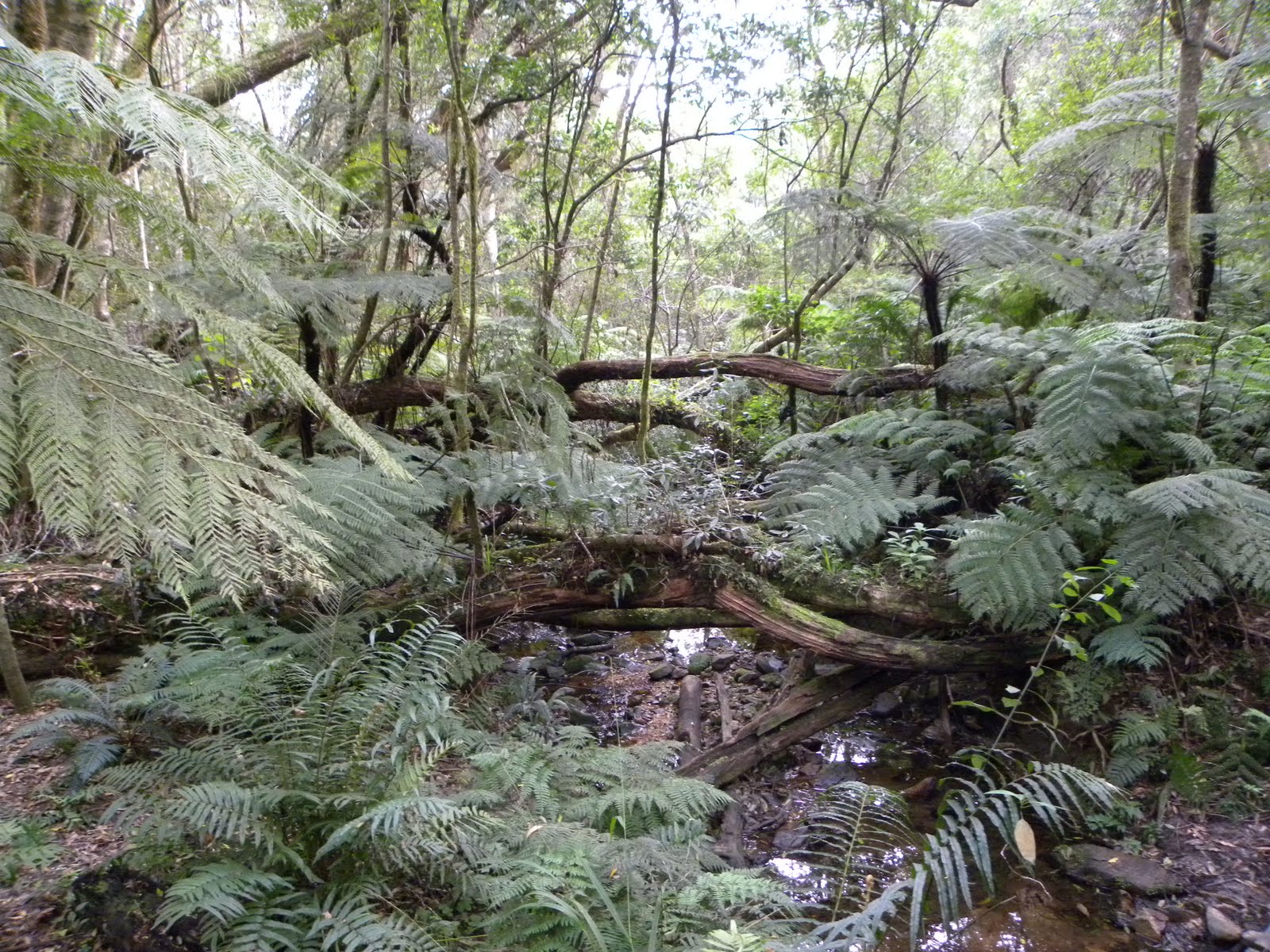
Not so in the second nature reserve, Knysna forest. The woods used to be the prime spot for lumberjacks to harvest trees for timber, and today it is still a massive forest with a lot of tree giants. As much I enjoyed the thick forest initially, it soon became boring as well. Most of the path I hiked was surrounded by such dense forest that I couldn’t see far. It was almost like walking through a green tunnel.

So I opted for a short walk, and went to see Bendigo – the first gold mine in South Africa.
Again, this sounds more impressive that it really is. A few shafts and old mining equipment was all that was there to admire. I guess if you really like shafts, you would have a blast, otherwise… not so much. So on to better nature reserves.

I reached Tsitsikama n

ature reserve, just across the provincial border and achieved my second goal.Tsitsikama, to me, sounds much more exotic than other places in Afrikaans, which I find quite basic: Bobejaanberg (baboon mountain), Oranje rivier (Orange river), Buffelfontein, (Buffalo spring)… But then again Tsitsikama means “place of a lot of water”, so it just sounds better to me. Perched at the coast of the Indian ocean, and with a number of waterfalls splashing on the rocks, the name is quite suitable.


The camping site at the ocean shore was definitely one of the most beautiful places I have ever pitched my tent.

The nature reserve is stunning, and I definitely will go back there. It has one of the most beautiful trails in South Africa, called the Otter trail. It takes 5 days to

complete the+/- 40 km hike which is named after the indigenous cape clawless otter. I hiked a long the first part of it and was absolutely awed by the beauty of the scenery. I did not see any cape clawless otter, but I did encounter a troop of baboons.

The first thing you should ask yourself when you see a baboon is: “where are the others?”. You won’t find a baboon by itself, it is always in a group. And if you were to find yourself too close or even in the middle of a baboon troop, you can be in very big trouble.


The teeth of a male baboon get as big as those of a lion, and it’s bite is stronger than a dog’s. No facts I’d like to verify myself. Applying the rule that a baboon is always in a group at other times, I have actually discovered quite a few troops whilst other passers by were already gone again.

The final nature reserve I visited was “De Hoop” (The Hope). Splendid reserve with quaint cottages you can rent for the weekend. Animals scattered all over the place, more than you can shake a stick at.

De Hoop is one of the p

laces you have a good chance of seeing whales. From the months of August to October, the whales come to the shores to deliver babies, catch up on some gossip, mate and do other whale stuff. So sure enough, when I walked to the beach, I saw 4 big lumps in the water. Thrilled by this sight, I ran closer and started taking pictures. Half an hour later, still al I saw were lumps in the water.Apparently it is too much to ask of a Southern Right Whale to jump out of the water or flip its tail. I assume heaving your body out of the water is too much of an effort if you weight 90 tons.

With the four nature reserves and all the magnificent sights along the road, I was content. I was even happier about my progress made in South Africanising, and had a couple of reasons for that.

First of all I assumed – and rightfully so- that there was going to be a braai area at the camping site. So I was equipped with brickets, meat and braai utensils. I ate rusks (dry, hard cookies) for breakfast and boerewors for supper. Better still, I had two routine police checks and didn’t incur a single fine! Talk about progress.

But there are still signs that I’m European. As a European, I am used to having petrol stations regularly along the road I drive. With South Africa being such a vast country and so sparsely populated however, you can go for hours on end without having a single chance to buy petrol. So when I went out to De Hoop reserve, for some strange inexplicable reason, I did not fill up my gas tank. I had a quarter left, and knew it would take me around 150kms. Just about enough to go to the reserve and reach the next town. But why not go for certainty and fill up where I am now? I had no idea, I blame the European in me. I ended up waiting for two hours in the reserve, to buy 5 liters of extra petrol to make sure I would reach my next destination. Not entirely South African after all.


more pictures on
here (http://www.facebook.com/album.php?aid=192393&id=730443433&l=e674e82aa8)

July 31, 2010

Coastal Break Out

Winter has not really broken through till now. It has been chilly at times, and rainy too, but the majority of the times we have blue skies and pleasant temperatures. Perfect hiking conditions, so I decided to take on Table Mountain again. I had not succeeded in hiking up the mountain yet. I had taken the cable car up before, yes, but I hadn't gone up on own strenght yet. The last attempt failed because the trail indicated simply vanished into tin air, and me and hiking buddy Florens were left scratching our heads, lookingdown a 50m drop. So this time I had a new route and a new buddy.

The hike up was perfect. Flowers are starting to blossom, the slopes are really green after the winter rains, and the sun is pouring warmth without burning skin. Since we left in the afternoon, we planned to hike up and take the cart down. We did not check the time of the last cart down though, which almost costed us deerly.
As we were an estimated 20min hike away from the cable cart station, we heard the alarm calling for the last ride. Not exactly the situation we had in mind. Not long later, we found ourselves huffing and puffing next to a technician who calmly explained we missed the last ride down. "looks like you have a hike left to do, guys. The counter is closed". Sun was setting and a hike down takes around 1.5 hours . Definitely not the plan we had in mind. We tried to apply logic to our predicament: "Sir, you have to go down. Can't we join you?". A chuckle and a puff of a cigarette followed. "I stay here, have to do some repairs tonight." We contemplated moving away from applying logic to downright pleading and begging when we saw restaurant staff getting ready to board the cart and go down. We joined the gang and went down enjoying the astonishing view of a setting sun over Cape Town. A pleasure all of you should see once in your life at least.

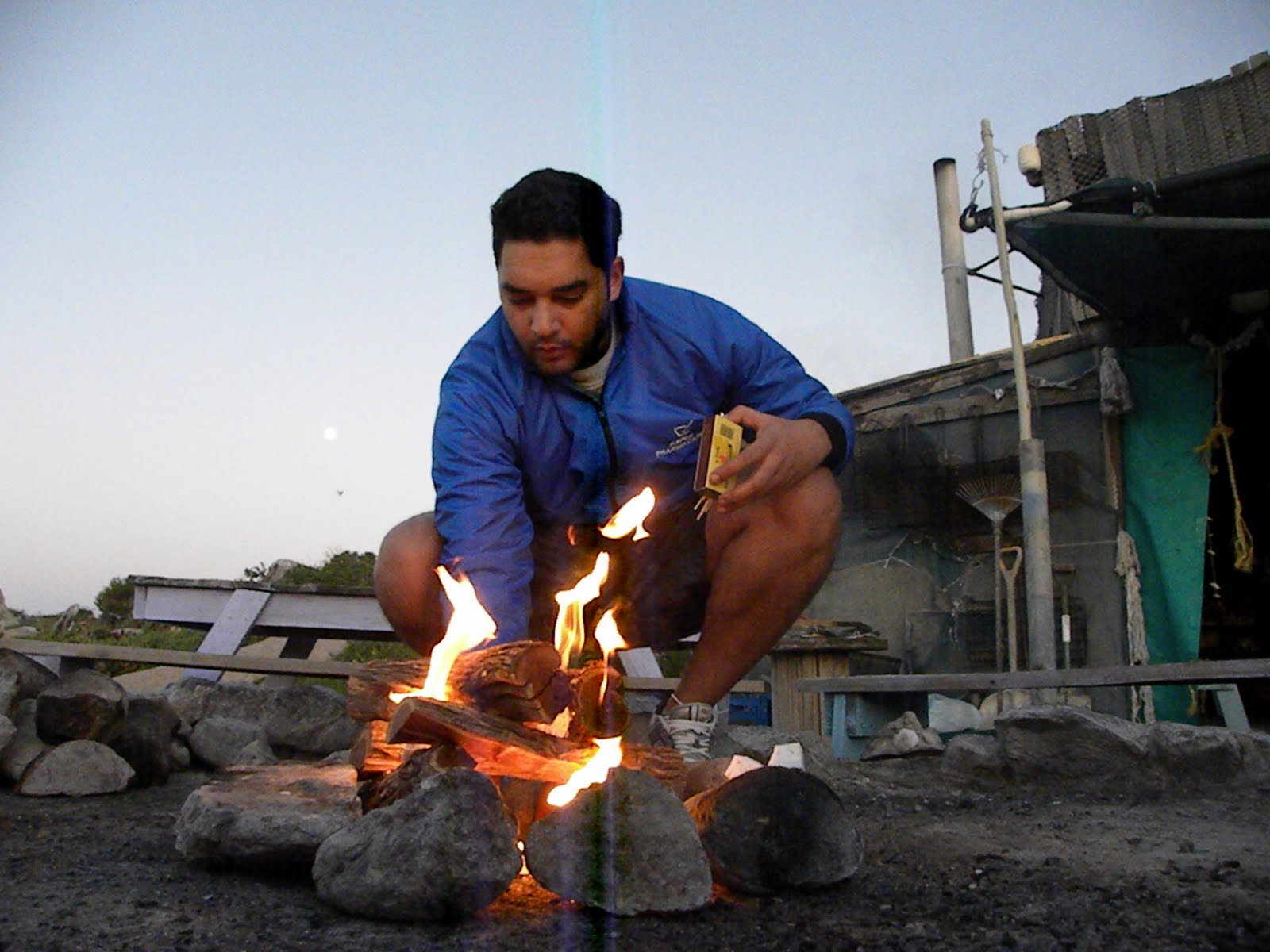
With nine months under the belt, and no leave taken, I am really feeling the urge of taking leave. Work doesn't really allow it at the moment, so I have to settle for less. I took a break out trip to a small town called Paternoster, on the West Coast, North of Cape Town. In a small Nature reserve, Rob (a friend and former colleague) and I slept in a nice camp site appropriately called Beach Camp. We did the usual camping things: hiked a bit, braai-ed our food, enjoyed a campfire and enjoyed nature.

As much good the trip did to me, it did not do much good to Shafeeka. Right before we reached destination, she lost thrust and roared like a madened cave bear. Something was wrong and I had a feeling I knew what it was. A visit to a specialist confirmed the diagnosis, a broken exhaust pipe where the pipe links to the silencer. Nothing terminal, but surgery was needed. So now she has a new exhaust, and purrs like a kitten again. The specialist said she needed new breaks and tires as well. I gave in on the breaks but not on the new tires. You shouldn't give a lady everything she needs right away.


FIFA World Cup


*** note, I had prepared this text some weeks ago, but forgot to upload it so now it is slightly outdated ***


The 2010 FIFA World Cup is over, with my favourite team (Spain) winning their first title ever. No longer do the news bulletins on the radio start with a countdown, and the couple of countdown clocks in town are now rendered useless. One newspaper headlined: "1430 days to go till next world cup", just to show how much South Africa was collectively living towards this tournament.


Previous hosting nations all suffered from a collective depression once the World Cup was over, and I am left wondering how that will affect the people here. One thing is absolutely sure, they showed all the sceptics wrong and organized a superb tournament. The media around the world wrote page after page about all the things that could go wrong in the first African edition of the biggest sporting event in the world. They talked about thieves and rapists, power shortages, terrorist attacks, stadiums not being ready, etc etc... and it is certain they scared away a lot of potential visitors. But none of those dreadful things happened. South Africa was well prepared. They had extra police and security forces around, agreed with neighbouring nations on backup plans should the SA electrical network fail, had navy vessels protecting the oceans and finalized all their world class stadiums in time. If you ever had safety concerns travelling through this country, now was the safest time ever. In fact, the few little incindents that happened were foreign tourists stealing or fighting. The specially erected legal courts gave quick trials to deal with the matter.
Of course there was going to be a lot of debate on a third world - and, moreover African - country hosting the costly event. It is very easily to argue that all those billions spent could have gone to public infrastructure, health care or similar. Then again, building those stadia, roads, hotels and taking care of catering, decoration, etc... provided a lot of jobs, a major cash injection and a positive effect on the economy in the middel long run. You can keep talking back and forward with $ amounts, I am personally convinced the biggest gain is in the untangible
benefits.


The feeling of togetherness and collective achievement can not be expressed in $. But it is certainly there. Never before have the South Africans been so united in supporting their national team Bafana Bafana. Never before have they all followed the world cup so closely. The vast majority of the country was debating the games, the rules, the results and dubious referee discussions, where a couple of months ago the news papers had a weekly feature of explaining the rules and introducing the football stars. Even South Africans themselves are pleasantly surprised that everything ran so smoothly. They certainly believe in themselves and each other a lot more. Let's hope they can bank on this feeling for a long time to come.

On a personal level, I am very happy to have been so close to all of this. Everyone knows I would not have followed the world cup so closely if it hadn't been on my doorstep. When I had to apply
for the tickets, I wasnt sure how many to buy. I applied for 4 games and got 3 tickets. But by sheer stupid luck of my friend Florens (the dutch guy you see on the side here), who unexpectadly got 4 tickets to all of the games, I got to go to witness more legendary games.
It was actually fun to see the likes of Maradonna, Nessi, Ronaldo, Forlan, Torres, Xavi, Villa and all those other stars in real life.

July 02, 2010

A taste of the DRC

One of the reasons why I applied for the job I currently have, was the possibility of travelling through Africa. It gives me the chance of going to places I would otherwise never consider spending scarce holiday time on. And that definitely applies to the Democratic Republic of the Congo, where I had to go to for a week.
I had to go to a place called Matadi, in the Western part of the country. So far away from the fights with the rebels in the Kivu provinces bordering Rwanda. In fact, the country is so big that thedistance from Matadi to those places is roughly the same distance as from my home town
to the Polish-White Russian border. And with their road infrastructure it would take weeks to
reach Matadi if they wanted to. So that leads us to two conclusions: one - I was safe from warlike violence and two - the road infrastructure of the DRC is bad.

In fact you can generalize that last statement to pretty much all infrastructure. Buildings look like they haven't been repaired in decades, which is probably also the case. The port I visited was build by the colonial power Belgium, in the early twentieth century. Since then most probably nothing was done to maintain the port in good condition. One indication would be the metal pillars supporting the quay side that were once as thick as a grown up man, and now are as thick as that man's arm. I assume this is what you get in a country that had a brutal civil war until recently and is one of the poorest in the world. How do you build up something if you don't have the building blocks to begin with?


I flew from Cape Town to Kinshasa, and then needed a short flight to Matadi. It is only 360 kilometres or so away, but because of the bad roads, you would lose too much time by driving there. You'd rather lose time, but slightly less of it, by waiting in a small airport for a flight with a blacklisted flight operator. I still haven't found out why they are blacklisted, and it was not that I had any other options, but it would have helped to know if I should be worried, or really worried. So there I was waiting for my flight with "Air Tropical".
The symbol of "Air Tropical" is a big elephant, which is probably the one creature in the whole animal kingdom that is the least likely to merily fly around. I guess "Air Tropical" can use a lesson or two in marketing. In spite of the ill chosen symbol and th
e blacklisting, wasn't really worried, to be honest. I figured that the pilots were not planning on crashing themselves, and since their job description says they have to actually be in the plane, I was convinced I would be ok flying with them. Still I couldn t help but looking at what they were doing, but that was only because I could look directly in the cockpit. It was undoubtedly the most
adventurous flight I have ever taken: a two propellor airplane with only 20 passengers, landing on an air strip consisting of trampled earth, and goats walking on it as we landed.

I was indeed safe from military conflicts, but there were potential other threats. Several exotic diseases with cool names but vicious effects were looming. For some of them I had a series of shots and a booklet to prove it. That vaccination booklet is as important as your passport, I was not allowed in or out of the country without it.
A disease you can't get vaccination s for is malaria, so I needed a way to deal with this omnipresent disease. Malaria is caused by a parasite that nests in your liver. All five types of malaria (there are 5, yes, there used to be 4 known but they discovered a new type recently) are transferred by the bite of an infected mosquito, turning that small creature into one of the most feared insects in the world. Malaria can be treated, but 2 types will never get out of your system.

You can imagine how happy I was to see the windows of my hotel room were equipped with a fine mosquito net. I was less enthused by the army of mosquitoes kept inside my room by that very net. A strategy was required. For part one of the strategy, I generously applied repellant all over me, making me smell like a giant bush of weird herbs. Secondly I wore a long sleeve shirt to sleep, and turned the airco down.
Mosquitoes only bite when the temperature is high enough. By making it nice and cold I was hoping to take their apetite away. And lastly I hopped and skipped around my room smacking and squashing as many mosquitoes as I could, wich made the walls and ceiling look like I emptied a tiny paintball gun on it
. I also improved my bruce-lee-squash, you know the one where you quickly grab a flying bug out of the air. I even made the appropriate kung fu squeels. As a final measure of precaution, I off course took malaria profylaxis (pills) and drank gin and tonic. The tonic contains kinine, a substance that makes mosquitoes not want to bite you.

With diseases taken care off, I more or less covered everything within my span of control. Bigger trouble makers that I could influence less were people. You see, the DRC is one of the countries were corruption is part of every day life. Coming from a first world country, with functioning governmental structures, functioning law and business rules, it is hard for me to deal with corruption. I don't like it, I don't condone it, I think it is wrong. But in many places where there are no structures, where law does not function an everyone is massively underpaid, corruption is a natural outcome. You give a guy a badge and he has power. You want to do something, you need a stamp or a paper from a guy with a badge.
But guess what, there is a problem or it is going to take longer than foreseen, or no no that is not possible... till a bank note appears and dissapears again. Then the papers show up, the problem is solved or they did find a solution. In other words, you need to lubricate a bit here and there. But in a poor country, a lot of lubrication is needed. And there are a lot of badges that need to provide paperwork. Who do you pay off? Who do you stand up to? How much should you give? Luckily the company provided help here. They provided a "fixer" for every transit I made in the DRC.

My fixer in Kinshasa was a middle aged, scrawny man. Neetly dressed, with spectacles balancing on a thin nose, he walked through a maze of people at the airports. Greeting many guards, talking to some, shaking hands, sometimes handshakes with bank notes in them, sometimes not. He made the process smooth. If I had to do all those things myself, it would have taken much longer and cost me dearly. I had read about travellers in the DRC having to buy their luggage back from airport personnel , or loosing their vaccination booklet because they handed it to the wrong customs officer. He also warned me not to take pictures.
I obviously had the exact opposite in mind. It turns out that the Congo is very wary of espionage. With several wars in recent past and ongoing fights I assume it is normal to be scared of any person documenting stuff. Coincidently, on my flight back to South Africa, I read in the newspaper that two Swedes were sentenced to death in the DRC, on the account of espionnage!! That could just as easily have been me! And also they had killed their driver or something, which I wasn't planning on doing, but still.

I assume you want to hear me describe what Kinshasa and Matadi were like? I am not going to spend too much time on that and let the pictures do the talking. Kinshasa is the dirtiest city I have ever visited, and that includes the cities in India. Very dusty, and soot everywhere because waste is burned in the streets and ashes mix with the sand. Traffic is a nightmare, as the roads
are in pispoor condition. But people smile a lot, and are friendly. They also like to remind me of the role of the Belgians in their recent history. Some did it to make me feel guilty, and
would be more inclined to give them almonds?, others because they seemed they finally wanted to confront a Belgian directly. Most remarcable was Yves, one of the guards at Matadi Airport. He blamed Belgium for not being a good coloniser. He said we should have left them with a Belgian language to speak, like the English did in Kenya. So I told him we were talking in French,
which is a Belgian language. But I was wrong, he said, because we speak Flamand et Wallon. How did French then end up being spoken in the Congo? He didn t know, but I was wrong and I was a bad colonist, because also - we did not found any university there. The whole conversation made me uneasy of course, but he could have made me feel much worse. In stead of telling me we should have founded universities, he could have questioned me on why "my king" came to steal copper, rubber and diamonds. Or why the Belgians choreographed the assasination of Lumumba, or why we allowed mercenary armies to cause bloodshed in his country, or why we backed up Rwandese rebel fractions invading the East, or why the Belgian army fought Arab slave traders only to start making slaves of Congolese themselves... I guess he either did not know about those dark pages in history, or those pages were written in Wallon in stead of French.

I'll start rounding off here, because I could write a lot more but I would digress from the reason of this blog. I'll just say I have seen, heard and read a lot of things which I find very fascinating.
The whole experience was a very good one, but I am glad it was not on my own account I went there. The Congo is very expensive, because everything is imported. The prices in the local supermarketare a lot higher than the ones in Belgium or Cape Town. Which is probably why someone is running a business importing goods from the Colruyt. That is right, everywhere I looked were items with the unmistakable "everyday" label, and prints in both French and Dutch. Oh, and the hotels I stayed in, even though they were average class, cost 240 EUR a night. So the plans I had of maybe making my way back to Europe in a car across the continent are put on ice for now.


June 01, 2010

Sport addicted

Never thought I would turn in to a real fan of any sport, but lately that is exactly what I have been doing.I ve been following the rugby competition here closely, going to every Super 14 game in Cape Town I could and even following games on television.
Because obviously I don't have any ties to any of the teams here, I chose the team of Cape Town as the side I would support. And it so happens that this team, The Stormers, had a great Super 14 season. In fact, they played the final of the Super 14 last weekend but lost against the Blue Bulls from Pretoria. So not the dreamed ending for the Stormers, but they had a fantastic season none the less. For me of course, it is even more fun to join a winning team.

As most people know, rugby is a big thing in South Africa, but mainly for the upper economic layer of society. That is a result of rugby being played at universities (they have an own competition) and because only whites were allowed to play it in the Apartheid time. In Cape Town you will see that the supporters are mainly Coloureds and Whites, the Blacks like football (soccer) as their prefered sport. In spite of this historically grown division, rugby is played more and more by people from all backgrounds.
You could say that South Africans are obsessed with sports. Next to rugby and football, they are crazy about cricket and golf, and follow a whole list of other sports. Most people played at least two or three sports when they were young. No wonder you find so many athletic types around here. Although having all these beaches, lovely nature and nice weather will probably have a hand in it too.


Any activity that requires a bit of energy can be turned into a competition and will be broadcasted on one of the 6 sports channels they have here. One example is professional sport fishing. I don't know what the appeal is in it, but you can see bulky guys fishing in rivers, ponds or oceans. They talk about the bait they use, the lines, the hooks, how to reel in the fish etc...

And they do catch the biggest fish imaginable, all shown on television. I wonder if those professional fishermen have large fan bases and if they have home grounds where they host fishing competitions and enjoy home advantage because they know what lure the fish like best...

To show all those sports, there are televisions everywhere. Every bar or restaurant, no matter how fancy or run down, has at least one television set to show sports. And sports are the one thing people seem to watch the most here. I am guessing now, but maybe they watch sports that much because they don't have that many soap operas or good entertainment on television. Surely, they have their own soap operas, like "Sevende Laan" which has the classic storylines of adultry, cancer, treason, illegitimate children and above all ever lasting love! (interestingly this show has conversations in 3, maybe 4 languages: Zulu, Xhosa, English and Afrikaans).


An other reason why maybe South Africans are so hung up on sports - and I am venturing a guess again- is because they are very good in a couple of sports. They have world class teams in cricket and rugby, they have extremely good golf players and other athletes like Oscar Pistorius aka Blade Runner (the paralympics sprinter with blades for legs who was olympic champion), Caster Semenya (the lady accused of being a man, remember that riot?). For a society that has so many great challenges in other areas, I can understand they would like to emphasize and enjoy the successes they have.

And now the sports question on everyone's lips is: will Bafana Bafana be a success? Bafana Bafana is the national football team of South Africa. Now, it would be appropriate to say that they suck. And that is a bit of an issue when you are hosting a world cup. Especially because no hosting nation was ever eliminated in the first round. So the yardstick of Bafana Bafana's success appropriately became: getting through the group phase (alive). They needed a man to turn a jumble of mediocre players in a strong team that could face the likes of Mexico, Germany, Uruguay etc... So they hired a Brazillian coach. He has been working those Bafana players for months now, in training camps in Germany and Brazil. And seems to be succeeding so far! He booked 11 victories in a row now. He'll need those success stories because Bafana is in the toughest pool of the tournament.

In 9 days, South Africa will play Mexico in the opening game. Be sure that you'll be able to cut the tension with a knife, and that the whole country will sound like a hornet's nest, because of those damn vuvuzelas.
I won't be there to see the game though. Not even on television, because at that time I will be travelling back from Matadi in the DRC. Just in time for the rugby game of France against South Africa, for which I still have to buy tickets...